
Developing Good Study Habits
Developing good study habits mean you use your time well. Time, of course, is the most valuable resource we have; but it's unbelievably easy to waste.
Improving your time management means you can decrease the time it takes to do your work but still increase the quality of what you produce.
In other words, less can produce more.
Before we go any further, remember that this is about developing good habits, not skills. Skills make you better at studying; effective habits make you better for studying.
Here's how:
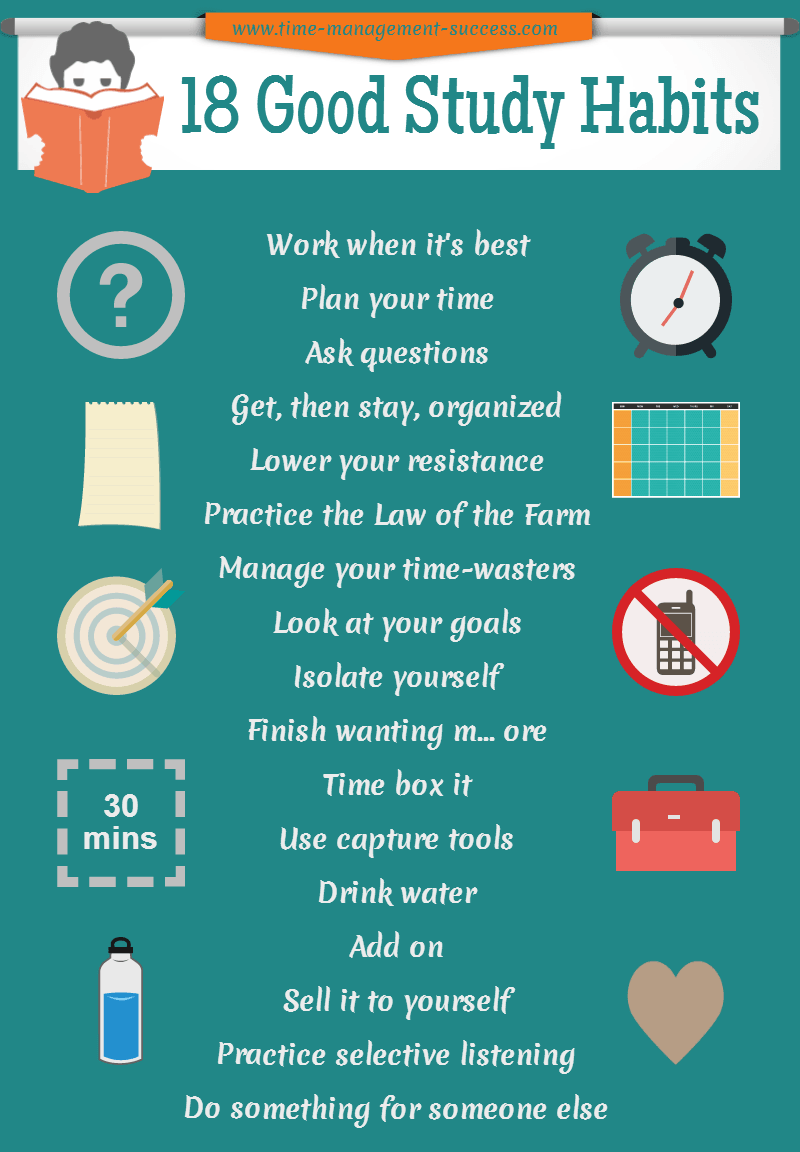

18 Good Study Habits Explained
1. Best time of day
When do you work best? Are you an early bird, night owl, or something in between? Find your rhythm, then plan to study at your most productive time.
2. Plan
The next day, week, term or semester. Whatever time frames you use, time you invest to plan will pay for itself many times over. Speculate to accumulate.
3. Ask questions
Of all the good study habits you can develop, this one is key. Just ask. If you don’t tend to do this, remember: success is defined by the number of uncomfortable conversations you’re willing to have.
4. Get, then stay, organized
Arrange your space, stuff, time and technology so they help, rather than hurt you. Once you learn how to get organized, make sure you stay that way.
5. Lower your resistance
One of the biggest time wasting ‘enemies’ you face? You! Part of you knows you should study, but another part of you wants to have some fun now. Using this Quick Win method daily can make all the difference.
6. Practice the law of the farm
Stephen Covey suggested that it’s better to study in the right season of time rather than cramming it all in at the last minute. A farmer can’t cram with crops. It has to be done in it’s season. Cramming may or may not get the grades, but it won’t get you an education.
7. Manage your time-wasters
Wasting time online often leaves you feeling bad afterwards. Software such as rescuetime is good for managing it, but the worst thing to do to stop is to try and stop it completely.
Give yourself permission to waste time within limits.
8. Look at your goal
One simple but highly effective habit is to constantly remind yourself what you’re studying for. Your dream grade, posted on the wall next to your bed or computer means you’ll see and think about it daily. In fact, of all the tips on setting goals, this one's a 'must do'.
9. Do the worst first
Each day, break off a bit of your hardest task. First thing is often the best time to do this. It limits the effect of the task on your mind if you do it early. You also get to feel good all day because it's done.
10. Isolate yourself
Turn your communications off when you study. Even better, put them out of site. If your phone rings or an email announces itself, what happens? Many people struggle with managing interruptions like these, and work grinds to a halt.
11. Finish wanting more
We all crave completion on anything, so leave yourself ‘high and dry’. If you stop working at a natural break, it’s nice and neat, but harder to start up again. Finish in the middle of a sente...
-- and you'll want to come back to it --
...nce.
12. Time box it
Give a task a block or 'box' of time to get it started. It needs to be short enough not to put you off, even if it’s a few minutes. Often, the thought of starting is the problem. But once you do, it’s easier to keep going.
Enough time boxed sessions will mean you finish it. Learn how to avoid procrastination by time boxing.
13. Use capture tools
Capture thoughts, ideas and concepts before they vanish into the ether. Good study habits depend on time management tools that are simple to use, easy to access and consistently work as a way to capture information that would otherwise be lost.
The key word there? ‘Use’.
14. Drink water
Stay topped up with enough to concentrate fully. Keep a bottle nearby, because good study habits depend on hydration.
15. Add on
Tack on a pre-study task to prepare yourself. The more your senses engage with this, the more effective it is. This is especially true with the sense of smell.
A certain odour (preferably pleasant!) can become a powerful anchor for developing good study habits.
16. Sell it to yourself
Thoughts become things or, to put it another way, we do what we think about. The see-your-goal example above is a simple way to start the process of marketing to yourself. Visual images, such as posters, have an impact, as does your language.
If you’ve ‘got‘ to work, it’s less than appealing than if you ‘decide’ to.
17. Practice selective listening
Listening is tough. When you do listen, do so really well. Identify the 20% of what's said that matters, and take it in. Use whatever capture tool you like -- just do it.
18. Do something for someone else
Help someone else, and you reinforced your own understanding. Ideally this will be with another student, but it doesn’t have to be. You could even explain it to yourself in the mirror.
Just make sure there is no one else in the house if you do. :)
* * *
The vast majority of what we do is habitual. Developing good study habits is a process you learn.
Some study skills and habits are easy to implement, others less so.
Whatever your experience, give these a go -- you’ll be a better student for it.
Comments
Share your thoughts in the box below...
What Other Visitors Have Said
Click below to see comments from other visitors to this page along with my replies ...
Study Style: Sleep When You're Dead
I usually spend most of my nights fighting sleep, trying to get everything done.
It's not that I procrastinate, it's that I work all day long and don't …
Understanding
Aiming for that A? This is how I did it...
I've realized that I never ever forget something once I've fully understood it. This way, you're being …
The Study Habits That Work For Me
I like to do one subject at a time. I start with setting a day to get all the reading material out of the way. From the lecture or the presentation or …
My Study Habits Tips
I am an early bird and find it best to study during the morning and early afternoon.
I turn off my cell phone (silence) and leave it in another …
Small Bites
It helps me if I break down my study time into small bites. I break off small sections of the material and focus on that until I feel comfortable …
Study Habits - Cynthia L B McQueen
I study best in an indoor, quiet atmosphere. I tend to get distracted easily by what's going on around me until I really get into the subject matter, …
Tips for Preparing to Study
I play Sudoku prior to any exam and to get myself geared up to study.
I figure this play time into my study time. Knowing that I'm doing some mental …
Getting Work Done
I start my study sessions with a review of notes from lecture. (Prior to lecture I read all assigned material and do all assigned learning activities …
My Study Habits
1) It has to be completely quiet. While I like to have the television on, I must mute it.
Tim: Me too, Laura, although I don’t have the television …
Completing the Task / Study Habits
I haven't actually "studied" for a long time, but I have always had plenty of work to do - pleasant and unpleasant.
I am first of all a list …
Connections
A couple of useful study strategies to help you work more efficiently…
Overlaps
One of the most underrated strategies is to find connections …
How I Use Notecards to Learn
I study best by making notecards or detailed notes and reading them out loud to myself over and over. By both reading and hearing the information, …
Study Habits
Organization and time management are two of the most critical components to developing good study habits.
If I begin my day unorganized I feel …
Effective Study Habits
How I Study Best
I study best in the early morning hours. This is the time that my thought process is at its best. If it's reading, first I …
Brief Study Tips
Freedom has offered a selection of study tips. My comments on each one are in italics...
Define your time. How much have you actually got? …
How I Study
Since I have been in my third year at university I feel my study practice has altered quite substantially compared to past habits.
For a start …
Struggling for Motivation?
This can help...
Related Articles:
- Home ›
- Good Study Habits