
Time Management for Teachers
Essential Tips if You Want a Life Outside School
The thorny issue of time management is one of the greatest causes of stress for educators.
It’s so easy to feel overwhelmed. There always seems to be more than enough to do, because, well... there is.
Work expands to fill the time we give it.
The three time zones of teaching
As a teacher, you need to manage three specific elements to your day:
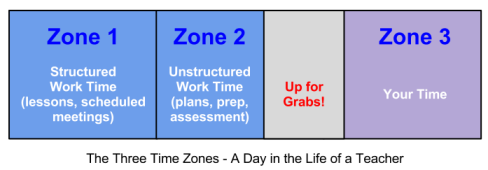

The boundaries between 1 to 2 and 1 to 3 are clear -- bells and buzzers set those for you.
The big question is, how do you manage the move from Zone 2 to 3?
When and where does work stop and personal life begin?
When you plan, prepare, assess students’ work, make the classroom displays, organize your paperwork or any of the other jobs do, you’re in Zone 2.
Zone 2 is all about quantity and quality.
It raises two questions…
- How much do you do?
- How well do you do it?
How much to do in Zone 2
Some Zone 2 activity is clearly defined. Once you’ve started it, sooner or later you have to finish it. You can’t give grades to most of a class -- you have to complete them all, usually to some sort of deadline. Other activities may not be deadline driven, but they still matter to you.
Here are two suggestions for Zone 2 success:
Make some time to plan your day
Preferably the day before, but certainly no later than first thing in the morning. Take 10 minutes daily to estimate what Zone 2 time you’ll get. Doing this really helps you take control -- you decide how you use your time rather than other people.
Break it down into chunks of time
Work on tasks that you have to, or want to, do. This means that you move on with large projects and tick off small tasks that you could, for example, batch together in a 30 minute slot.
Let’s say your classes finish at 3.30pm. You plan to leave school at 5.00pm. (If you create a good reason to do so, it helps). Your Zone 2 time may consist of this 90 minute slot, plus an hour or two during the day.
So, you have approximately three hours in Zone 2 (and that time will include interruptions, ‘emergencies’ and ‘have to’s’ -- plan for two; anything else is a bonus).
Aim to work on a role or goal related task for a length of time -- say, 30 minutes. Unless it’s urgent, move on to another task.
If you want to take the task beyond the time slot you allocated it, take a minute to consider the effects of not doing the next task on your list. Can it wait? If so, fine, carry on.
One 'solution' to better time management for teachers is to take work home in the evening. This is understandable because it takes some of the pressure off the day, and you spend less time managing interruptions (depending on your circumstances).
It’s worth remembering two things though…

- Evenings and weekends have their own Zone 2 times. There is usually less time available than it seems when we say “I’ll do it tonight”. How much time do you have left in an evening after you've done all you need to do?
- Planning to work at home means Zone 2 time in school is less valued, so there are more reasons to procrastinate during the day. It's so easy to think 'I've got all evening -- I'll do it later'. You have limited Zone 2 time each day, and it is probably less than you think.
Good time management for teachers means knowing when to be 'unperfect'
When we try to do too much and/or too well, stress is often the result.
Of course, quality is important, even essential at times. But developing the ability to know when ‘good enough’ is good enough is a vital part of effective time management for teachers. Apply the 80-20 rule at work.
When I started my teaching career I came home every day feeling completely wiped out.
In part, that was to be expected -- making the transition from student to teacher is a huge challenge.
In my desire to prove myself, I was giving everything to everyone.
Thankfully, in my first year of teaching, an older and wiser colleague gave me one of the best pieces of advice I ever received:
Choose carefully what you give 100% to.
He was right. Recognize what needs 100% and what doesn’t.
We all get that wrong from time to time...
Sometimes we try too hard, even to the point of experiencing burnout as a result.
At other times we don’t try hard enough. Practice this, and stay aware of it to gradually improve the accuracy of your estimates.
So, successful time management for teachers depends on four criteria. You simply have to improve your ability to:
- Decide what to do.
- Start it.
- Finish it.
- Accept it.
Get better at the this process and you’ll save yourself hundreds, even thousands of hours -- hours you can use to do more of what matters to you.
If you’ve made it this far through this article (well done, by the way!), you’ll almost certainly improve your time management.
Why?
Because getting to this point suggests you’re interested in filling less and using more of your time. That fact alone will put you on the path to a better understanding of the importance of time management for teachers such as yourself and consequently a better application of it than the vast majority of your colleagues achieve.
Time management for teachers will always be a challenge. Use this page to help you spend less time doing what you have to and more time doing what you want to do.
How Do YOU Manage Your Time?
Do you have time to teach and still have a life outside the classroom?
Take a moment to answer any or all of the following questions...
- What do you think are the biggest challenges facing teachers in terms of time management?
- What do you feel are common causes of distraction for you as a teacher?
- Can teachers actually do their job without experiencing excessive stress? If not, why not? If so, how?
- If you were mentoring a Newly Qualified Teacher, what 3 time management tips would you give them?
- Could you outline your routine or system that you use to help you manage your time?
Whether you want to write a couple of lines or an in-depth article, start by entering the title of your contribution below and get yourself noticed on the Net!
What Other Visitors Have Said
Click below to see contributions from other visitors to this page...
How I Manage My Time
I try to get as much work related to teaching and the classroom done at school. I either go in early or stay at work after my working hours. My biggest …
Frustrated and Overloaded High School Teacher With Too Many Hats
Here's a selection of classic time related issues that teachers face. If you’re interested, scroll down for my response.
1. The biggest challenges …
One Bite at a Time
When I was a teenager, more than a few years ago, I read an article called "How to Eat an Elephant". I don't remember the specifics of the article but …
3 Tips That Work For Me
1. When writing a “to do” list, instead of simply writing a list of jobs, I write 4! The first list is for absolutely essential, must be done things. …
Lessons From A Computer Operating System
Do the shortest job first (This is a scheduling protocol borrowed from computer operating systems. Doing the shortest job first means that the average …
Tips from a Preschool/Kindergarten Montessori Teacher
My suggestions would be to keep a routine, ie. use each day's planning period for specific, routine tasks that are reocurring, if not daily, then …
My Time Management As A Teacher
I think there are really three main challenges as a teacher
One, the job never finishes (it is always possible to plan better, mark more, …
Getting Things Done, Organizing Time
and Saying No
Here are 3 things I do:
Getting things done
I make sure I always have something to look forward to at the end of the job I am getting out …
What Works For Me
Being a teacher means I work long hours in an intense job, so time management is important.
Here are some time management tips that I find …
Do you need to get a better balance in your life?
Click below to check out the
Time Management Success
e-book!
Related Articles:
- Home ›
- Time Management for Teachers