
How to be Productive at Work
and Leave on Time

Unless you know how to be productive at work it's too easy to end up being there longer then you want to. 5pm soon becomes 5.30, then 6...
Before you know it you've missed dinner with the family again. It's too late to see the kids before bedtime (and you're definitely too tired to go out for the evening).
We've all been there (or not been there in this case).
In a strange way being at work is seductive. It so easily lulls us into thinking we're working when, in truth we're not. Being there is not the same as being productive.
It's easily done, but it's a habit that hurts unless you address it.
Here's how to be productive at work and still get away at a reasonable time.
It's all about the system
Three things will determine your productivity: motivation, willpower and the system you use for doing things.
The first two, motivation and willpower, are fickle. Sometimes you can feel full of zest and zeal about your work. At other times you’re sluggish and struggling. In short, they’re not reliable when it comes to doing what you decided to get done.
To get stuff done you'll do much better if you set up and use a system; you’re virtually guaranteed to boost your productivity, even (especially) when your motivation and will-power are lacking.
Essentially, working systematically saves us from ourselves:
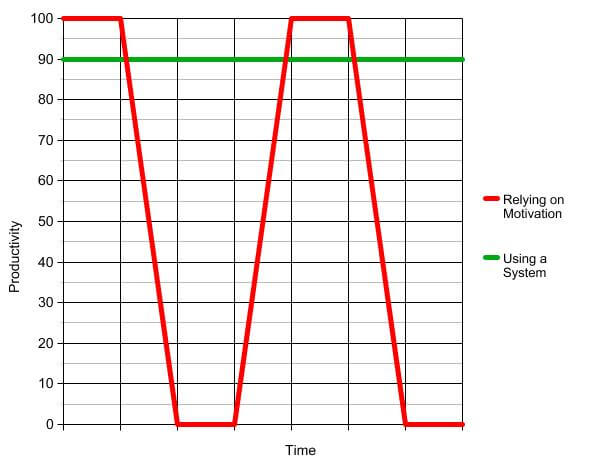
If you want to know how to be more productive, try this simple two-step system to manage your time and your tasks. You’ll get more of what matters done.
Here’s how to be productive even when you don’t feel like being so:
Know your work
You don’t have to be excited about all (or any) of it, but at least know what your work actually consists of.
At this point it’s tempting to sit down with a pen and paper and to make a long list of all the things you’ve got to do. This is useful for when a backlog of things to do has built up, in which case, you’ll probably need to know how to prioritize work according to urgency.
But, as far as possible, work daily on all of your roles, goals, daily tasks and ongoing projects along with what comes in during one day.
Unless it is genuinely same-day urgent, list everything that comes in today in your daily planner under tomorrow’s date.
This will give you a list that consists of the following:
- Roles
- Goals
- Current projects
- One off tasks
- Mail to act on
- Mail to be processed
Bottom line?
Finish each day knowing exactly what you’re going to do tomorrow.
Do what you want
Knowing how to be productive when you don’t feel motivated or have the will power, hinges on reducing your internal resistance to the point that you actually do something.
The best way to do that? Work on everything you must (i.e the list you defined above) for as long as you want to. The key here is that you overcome the inertia that quickly causes work to back up.
This works well for roles and goals which are important but not urgent. Even when you don’t feel like doing anything you can be more productive than you previously would have been by just doing a little bit every day.
What about dealing with the seemingly never ending stream of daily tasks such as emails?
You have to at least read them (well, the title) so you can delete or defer everything from today. Action those from the previous day and you’ll end up with an empty inbox.
Bottom line?
Even on the days you’re in a mental slump, you can still get things done and improve your time management at work.
Just reduce the resistance you feel to what you’ve got to do. You’ll soon realize you know how to be productive even when you don’t feel like it.
If you know how to be productive at those times you'll get away on time and home to the people that really matter.
Do you need to get a better balance in your life?
Click below to check out the
Time Management Success
e-book!
- Home ›
- Time Management in the Workplace ›
- How to Be Productive